
异常介绍
异常机制注意事项
- 性能问题
- 指针和动态分配导致的内存回收问题:动态内存不会自动回收
- 函数的异常抛出列表:如果没有写
noexcept,意味着你可以抛出任何异常
基本语法
异常捕获
try
{
}
catch( ExceptionName e1 )
{
}
catch( ExceptionName e2 )
{
}
// 捕获所有异常
catch( ... )
{

}抛出异常
throw "异常";异常捕获
try{
    // 可能抛出异常的语句
}
// exceptionType:当前 catch 可以处理什么类型的异常。
// variable:捕获到的异常变量
catch(exceptionType variable){
    // 处理异常的语句
}

/**
* 不获取异常数据
*/
try{
    // 可能抛出异常的语句
}
catch(exceptionType){
    // 处理异常的语句
}catch 进行异常捕获的特点:
- 异常是在运行阶段产生的,没法提前预测,只能等到程序运行后,真的抛出异常了,再将异常类型和 catch 能处理的类型进行匹配,匹配成功的话就调用当前的 catch,否则就忽略当前的 catch。
- 在多级 catch 中,异常会从上到下按照顺序匹配,且最多只会进入一个 catch
- 异常变量会进行类型转换
- 算数转换:例如 int 转换为 float,char 转换为 int,double 转换为 int 等
- 向上转型:也就是派生类向基类的转换
- const 转换:例如将 char * 转换为 const char *
- 数组或函数指针转换
抛出异常
Note
异常必须显式地抛出,即throw 异常。如果没有显式的抛出,即使有异常也检测不到。
throw 异常数据;异常数据的类型可以是:int、float、bool 等基本类型,也可以是指针、数组、字符串、结构体、类等聚合类型。正规一点就使用exception类
Note
可以限定函数可以抛出哪些类型的异常,但是不要使用。
double func (char param) throw (int, char, exception);exception 类
定义
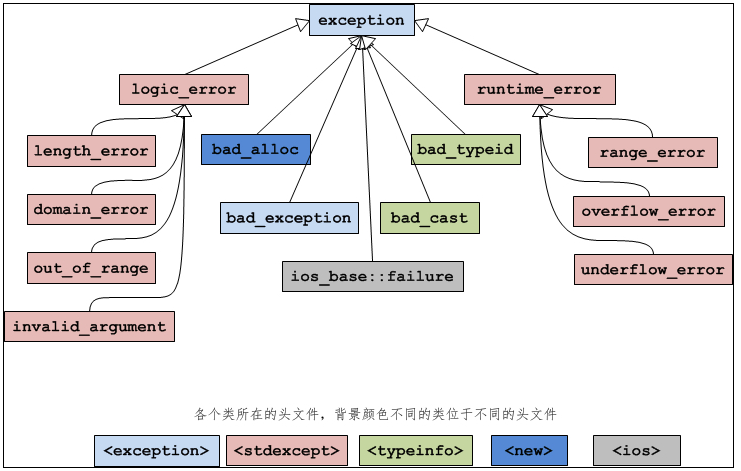
C++语言本身或者标准库抛出的异常都是 exception 的子类
#include <exception>

class exception{
public:
    exception () throw();  //构造函数
    exception (const exception&) throw();  //拷贝构造函数
    exception& operator= (const exception&) throw();  //运算符重载
    virtual ~exception() throw();  //虚析构函数
    virtual const char* what() const throw();  //虚函数
}可以通过该类捕获所有 exception 的子类
try{
    //可能抛出异常的语句
}catch(exception &e){
    //处理异常的语句
}标准异常
异常类型:
| 异常名称 | 含义 |
|---|---|
| logic_error | 逻辑错误。 |
| runtime_error | 运行时错误。 |
| bad_alloc | 使用 new 或 new[ ] 分配内存失败时抛出的异常。 |
| bad_typeid | 使用 typeid 操作一个 NULL 指针,而且该指针是带有虚函数的类,这时抛出 bad_typeid 异常。 |
| bad_cast | 使用 dynamic_cast 转换失败时抛出的异常。 |
| ios_base::failure | io 过程中出现的异常。 |
| bad_exception | 这是个特殊的异常,如果函数的异常列表里声明了bad_exception 异常,当函数内部抛出了异常列表中没有的异常时,如果调用的 unexpected() 函数中抛出了异常,不论什么类型,都会被替换为 bad_exception 类型。 |
逻辑错误异常:
| 异常名称 | 含义 |
|---|---|
| length_error | 试图生成一个超出该类型最大长度的对象时抛出该异常,例如 vector 的 resize 操作。 |
| domain_error | 参数的值域错误,主要用在数学函数中,例如使用一个负值调用只能操作非负数的函数。 |
| out_of_range | 超出有效范围。 |
| invalid_argument | 参数不合适。在标准库中,当利用string对象构造 bitset 时,而 string 中的字符不是 0 或1 的时候,抛出该异常。 |
运行时异常:
| 异常名称 | 含义 |
|---|---|
| range_error | 计算结果超出了有意义的值域范围。 |
| overflow_error | 算术计算上溢。 |
| underflow_error | 算术计算下溢。 |
构造函数异常
构造函数中抛出异常的特点
- 构造函数抛出异常之后,对象将不被创建
- 对象没有被创建,显然也不会调用析构函数
- 已经创建的成员变量(非
new、malloc创建的)会被部分逆序析构 - 为了防止泄漏,已经完成动态内存分配的需要在
catch中手动释放
class Student
{
public:
    Student()
    {
        a = nullptr;
        try
        {
            a = new int[10]();
            throw "test";
        }
        catch(...)
        {
            if (a != nullptr)
            {
                delete [] a;
                a = nullptr;
            }
            // 释放完毕后,再抛出异常
            throw "test";
        }
    }
private:
    // 非动态申请的变量,会自动释放
    Teacher tch;

    // 动态创建的需要手动处理一下
    int *a;
}Tip
std::nothrow 只能屏蔽系统分配内存时产生的 std::bad_alloc 异常,其他异常还是要 try catch
函数 try 块
函数直接处理异常,不用在函数外部进行捕获
int Fcn(int a)try
{
   throw 1;
   return 10;
}
catch(int e)
{
    std::cout << e << std::endl;
    // 可以进行值返回
    return 11;
}退出方式
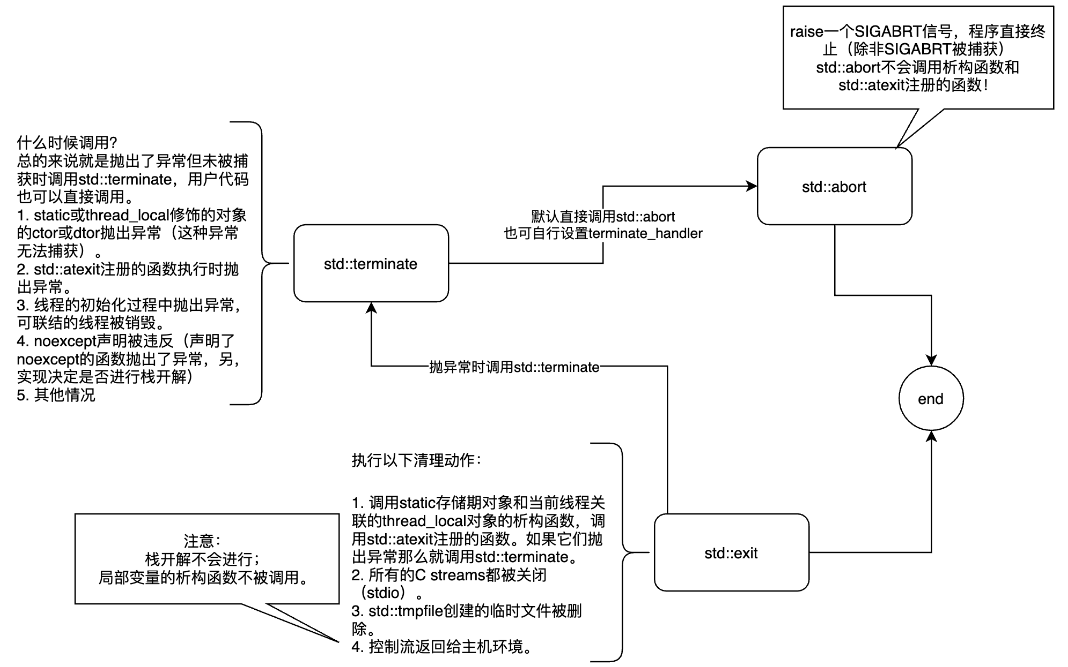
- std::exit: 用于正常流程退出,由用户显式调用。main 函数返回,也是调用这个
- std::abort: 终止进程
- std::terminate: 异常退出,由内部的库函数调用
Note
exit 与 abort 不管在哪里被调用,都会直接终止「程序」。
异常处理 (MSVC)
异常处理机制
在 MSVC 编译器中有三种异常处理方式:
-
C++ exception handing : 标准的
C++异常处理机制 -
Structured exception handing : 微软定义的异常处理机制,即
SEH,推荐在C程序中使用 -
MFC exception : 上古产物
C++ exception handing
#include <stdexcept>
#include <limits>
#include <iostream>

using namespace std;

void MyFunc(int c)
{
    if (c > numeric_limits< char> ::max())
        throw invalid_argument("MyFunc argument too large.");
    //...
}

int main()
{
    try
    {
        MyFunc(256); //cause an exception to throw
    }

    catch (invalid_argument& e)
    {
        cerr << e.what() << endl;
        return -1;
    }
    //...
    return 0;
}Structured exception handing
基本语法
SEH
的基本语法规则为 try-except 和 try-finally,是为 C 程序设计的。try-except 和 try-finally 也被称之为 Frame-based Exception Handler
// __except 过滤 __try 中的异常
__try {
    // guarded code
}
__except ( /* filter expression */ ) {
    // termination code
}

// 在 __try 异常或正常退出后,__finally 都会执行
__try {
    // guarded code
}
__finally {
    // termination code
}try-except 的 filter 表达式用法和try-catch 不同
#include <Windows.h>

// filter expression 的返回值
// EXCEPTION_EXECUTE_HANDLER      1 : 异常可识别。 通过执行 __except
// EXCEPTION_CONTINUE_SEARCH      0 : 异常不被识别
// EXCEPTION_CONTINUE_EXECUTION (-1) : 异常可识别,但被关闭。 从出现异常的点继续执行。
int filter(LPEXCEPTION_POINTERS pInfo, DWORD nCode){

    // filter 表达式的返回值
    int nRes = EXCEPTION_CONTINUE_SEARCH;

    // 除 0 异常
    if(pInfo->ExceptionRecord->ExceptionCode == EXCEPTION_INT_DIVIDE_BY_ZERO){
        nRes = EXCEPTION_EXECUTE_HANDLER;
    }

    return nRes;
}

int main(int argc, char const *argv[])
{
    /*
        typedef struct _EXCEPTION_POINTERS {
            PEXCEPTION_RECORD ExceptionRecord;
            PCONTEXT          ContextRecord;
        } EXCEPTION_POINTERS, *PEXCEPTION_POINTERS;
    */
    LPEXCEPTION_POINTERS pInfo;

    __try{
        // 抛出异常
        RaiseException(EXCEPTION_INT_DIVIDE_BY_ZERO,0,0,NULL);
    }

    // NOTE - 这两个宏只能在 __except 中使用
    // GetExceptionInformation() :异常信息
    // GetExceptionCode() : 异常编号,同 LPEXCEPTION_POINTERS::ExceptionRecord::ExceptionCode
    __except(pInfo = GetExceptionInformation(),filter(pInfo, GetExceptionCode())){
        printf("EXCEPTION_INT_DIVIDE_BY_ZERO\n");

        // 可以直接通过 LPEXCEPTION_POINTERS::ContextRecord 修改进程状态,来修复程序
        pInfo.ContextRecord;
    }

    return 0;
}通过 UnhandledExceptionFilter 与 SetUnhandledExceptionFilter 能对没有人接收的异常进行最后一次过滤
// NOTE - 只能在 filter expression 使用
// 有 debuger 时,倾向于将 unhandled exceptions 递交给 debuger
// 有 debuger : 返回 EXCEPTION_CONTINUE_SEARCH
// 无 debuger : 返回 EXCEPTION_EXECUTE_HANDLER
LONG UnhandledExceptionFilter(
  [in] _EXCEPTION_POINTERS *ExceptionInfo
);


// 为每一个线程设置一个 top-level exception handler。当进程没有被 debug 时,UnhandledExceptionFilter 得到控制处理权,就会调用 lpTopLevelExceptionFilter 来过滤异常
LPTOP_LEVEL_EXCEPTION_FILTER SetUnhandledExceptionFilter(
  [in] LPTOP_LEVEL_EXCEPTION_FILTER lpTopLevelExceptionFilter
);

typedef LONG (WINAPI *PTOP_LEVEL_EXCEPTION_FILTER)(
    _In_ struct _EXCEPTION_POINTERS *ExceptionInfo
);

typedef PTOP_LEVEL_EXCEPTION_FILTER LPTOP_LEVEL_EXCEPTION_FILTER;调用顺序测试
#include <stdio.h>

#include <Windows.h>

int filter(LPEXCEPTION_POINTERS pInfo, DWORD nCode){

    int nRes = EXCEPTION_CONTINUE_SEARCH;

    printf("1\n");
    UnhandledExceptionFilter(pInfo);
    printf("2\n");

    if(pInfo->ExceptionRecord->ExceptionCode == EXCEPTION_INT_DIVIDE_BY_ZERO){
        nRes = EXCEPTION_EXECUTE_HANDLER;
    }

    return nRes;
}

LONG testFilter(_In_ struct _EXCEPTION_POINTERS* ExceptionInfo){
    printf("3\n");
    return 1;
}

int main(int argc, char const *argv[])
{
    SetUnhandledExceptionFilter(testFilter);

    __try{
        // 抛出异常
        RaiseException(EXCEPTION_INT_DIVIDE_BY_ZERO,0,0,NULL);
    }

    __except(filter(GetExceptionInformation(), GetExceptionCode())){
        printf("4\n");
    }


    return 0;
}异常类型
SEH 能处理的异常有:
- 硬件异常: 由 CPU 发起,某些指令出错,例如除0、内存访问异常
- 软件异常: 由应用程序或者操作系统发起,程序逻辑出错,例如无效参数。
- 应用程序:代码逻辑里面主动调用
RaiseException产生异常 - 操作系统:当操作系统检测到软件异常时,会由当前线程调用
RaiseException产生异常
- 应用程序:代码逻辑里面主动调用
通过 GetExceptionInformation 能获取CONTEXT 存储线程堆栈信息与EXCEPTION_RECORD 存储异常信息。在默认情况下 Floating-Point Exceptions 是关闭的,因此运算结果只返回 NAN 或者 INFINITY
异常处理

handler 的查询过程又分为用户态与内核态:
-
用户态
- 通知 debuger 接收
- debuger 未找到或不处理。搜索
frame-based exception handler,优先搜索产异常线程的栈,然后是其他的 - frame-based exception handler 未找到或不处理,二次通知 debuger
- debuger 未找到或不处理,则调用系统的默认 handler, 一般是
ExitProcess
-
内核态:在内核的栈帧中查找相关的 handler ,没有找到就调用
ExitWindows
Debugger Exception Handling
用户态程序接入 debuger 后,操作系统在检测到程序发生异常后会生成一个 debug event,且 debuger 通过 WaitForDebugEvent 接收该事件,并通过 DEBUG_EVENT 获取线程号和异常信息 EXCEPTION_DEBUG_INFO。
debuger 也有两次处理异常的机会
first-chance notification: 用于 debuger 处理断点与单步调试异常。用户可以修改程序环境,在 handler 执行之前last-chance notification: frame-based exception handler 没有被找到,让 debuger 兜底
调用 ContinueDebugEvent 向操作系统报告异常处理情况并将控制权返还给操作系统。在返回之前,debuger 就能处理异常或者修改线程状态
Vectored Exception Handling
VEH (Vectored Exception Handling) 是 SEH 的拓展。VEH 不是 Frame-based Exception Handler,在 VEH 中注册的 handler 会在 a first chance notification 被调用。
- vectored continue handler:
AddVectoredContinueHandler与RemoveVectoredContinueHandler实现添加与删除 - vectored exception handler:
AddVectoredExceptionHandler与RemoveVectoredExceptionHandler实现添加与删除
SHE与标准异常机制
structured exception handling 与 C++ exception handling 的主要区别是
- 异常类型的定义不同。C 的异常类型是一个
unsigned int,C++ 则是一个对象 - SEH 是异步的;C++ 标准异常则是同步
Note
通过 /EHa /EHsc /EHs配置, SEH 能在 C++ 中进行使用,但是在某些情况局部变量的析构函数不会被调用,因此微软推荐C++使用 try-catch。
-
/EHsc /EHs:try-catch不会捕获 SHE 的异常 -
/EHa:try-catch能捕获 SHE 的异常
上述问题最好的解决方案就是在 C++ 中混用 SHE :C++ 的异常处理就是标准,C 的异常处理就用 SHE
// exceptions_Exception_Handling_Differences.cpp
// compile with: /EHa
#include <iostream>

using namespace std;
void SEHFunc( void );

int main() {
   try {
      SEHFunc();
   }
   catch( ... ) {
      cout << "Caught a C exception."<< endl;
   }
}

void SEHFunc() {
   __try {
      int x, y = 0;
      x = 5 / y;
   }
   __finally {
      cout << "In finally." << endl;
   }
}上面的处理方式 try-catch 只能捕捉到 SHE 出现了异常,但是并不能识别出异常类型,这就需要对 SHE 的异常进行封装。
// exceptions_Exception_Handling_Differences3.cpp
// compile with: /EHa
#include <stdio.h>
#include <eh.h>
#include <windows.h>

class SE_Exception {
private:
   SE_Exception() {}
   unsigned int nSE;
public:
   SE_Exception( SE_Exception& e) : nSE(e.nSE) {}
   SE_Exception(unsigned int n) : nSE(n) {}
   ~SE_Exception() {}
   unsigned int getSeNumber() { return nSE; }
};

void SEFunc() {
    __try {
        int x, y = 0;
        x = 5 / y;
    }
    __finally {
        printf_s( "In finally\n" );
    }
}

void trans_func( unsigned int u, _EXCEPTION_POINTERS* pExp ) {
    printf_s( "In trans_func.\n" );

    // 抛出 C++ 标准类型的异常
    throw SE_Exception( u );
}

int main() {
    // 注册 SHE 中转处理函数
    _set_se_translator( trans_func );

    try {
        SEFunc();
    }
    catch( SE_Exception e ) {
        printf_s( "Caught a __try exception with SE_Exception.\n" );
        printf_s( "nSE = 0x%x\n", e.getSeNumber() );
    }
}附加
逻辑检测
Note
检测代码逻辑错误,应当使用 assert,而非 exception
- 不要在
assert中写业务逻辑,只能写检测逻辑
release 与 debug 版本中, assert 的执行逻辑不一样。通过宏 NDEBUG 进行切换
#include <assert.h>

// 在 release 中 ASSERT 不会执行
// 在 debug 中 ASSERT 会执行
assert(nM++ > 0); // Don't do this!
- crtdbg.h 微软提供的带弹窗的断言
release 与 debug 版本中,通过宏 _DEBUG 进行切换,且运行时库得使用 debug 版,即 /MTd,/MDd
#ifndef _ASSERT_EXPR
    #define _ASSERT_EXPR(expr, msg) \
        (void)(                                                                                     \
            (!!(expr)) ||                                                                           \
            (1 != _CrtDbgReportW(_CRT_ASSERT, _CRT_WIDE(__FILE__), __LINE__, NULL, L"%ls", msg)) || \
            (_CrtDbgBreak(), 0)                                                                     \
        )
#endif

// 不会打印判断条件
#ifndef _ASSERT
    #define _ASSERT(expr) _ASSERT_EXPR((expr), NULL)
#endif

// 会打印判断条件
#ifndef _ASSERTE
    #define _ASSERTE(expr) _ASSERT_EXPR((expr), _CRT_WIDE(#expr))
#endif