
宏
#、##
// 转字符串
#define STR(a) #a
// 拼接内容
#define JOINT(a,b) a##b

int main(int argc, char const *argv[])
{
    const char * str = STR(hello);

    int a1 = 2;
    int a2 = 3;
    int b = JOINT(a,1); // int b = a1
    int c = JOINT(a,2); // int c = a2
    return 0;
}
// 转字符串
#define STR(a) #a
// 拼接内容
#define JOINT(a,b) a##b
int main(int argc, char const *argv[])
{
const char * str = STR(hello);
int a1 = 2;
int a2 = 3;
int b = JOINT(a,1); // int b = a1
int c = JOINT(a,2); // int c = a2
return 0;
}
删除宏
#define TEST ffff

// 删除宏
#undef TEST
#define TEST ffff
// 删除宏
#undef TEST
变参宏
#include <iostream>

// 参数展开并拼接成字符串
#define show(...) puts(#__VA_ARGS__)

#define call(Fcn, ...) Fcn(__VA_ARGS__)

int main(int argc, char const *argv[])
{
    show(1,2,3,4);

    call([](int a, int b){}, 1, 10);
    return 0;
}
#include <iostream>
// 参数展开并拼接成字符串
#define show(...) puts(#__VA_ARGS__)
#define call(Fcn, ...) Fcn(__VA_ARGS__)
int main(int argc, char const *argv[])
{
show(1,2,3,4);
call([](int a, int b){}, 1, 10);
return 0;
}
反射宏
- 结构体定义头文件
/* ================== dataDefine.h ================= */

// 结构体的名
#ifndef data_name
#error not found data_name
#endif

// 结构体内部字段定义
#ifndef data_body
#error not found data_body
#endif

struct data_name{

// 自定义 int、doule 的展开形式
#undef field_int
#define field_int(name,...) int name = {__VA_ARGS__}

#undef field_double
#define field_double(name,...) double name = {__VA_ARGS__}

// 展开自定义字段
    data_body
};

std::ostream& operator<<(std::ostream & os, const data_name & t){

// 自定义字段的序列化输出形式
#undef field_int
#define field_int(name,...) os << #name " "  << t.name << std::endl;

#undef field_double
#define field_double(name,...) os << #name " " << t.name << std::endl;

// 展开自定义字段
    data_body
    return os;
}

#undef data_name
#undef data_body
/* ================== dataDefine.h ================= */
// 结构体的名
#ifndef data_name
#error not found data_name
#endif
// 结构体内部字段定义
#ifndef data_body
#error not found data_body
#endif
struct data_name{
// 自定义 int、doule 的展开形式
#undef field_int
#define field_int(name,...) int name = {__VA_ARGS__}
#undef field_double
#define field_double(name,...) double name = {__VA_ARGS__}
// 展开自定义字段
data_body
};
std::ostream& operator<<(std::ostream & os, const data_name & t){
// 自定义字段的序列化输出形式
#undef field_int
#define field_int(name,...) os << #name " " << t.name << std::endl;
#undef field_double
#define field_double(name,...) os << #name " " << t.name << std::endl;
// 展开自定义字段
data_body
return os;
}
#undef data_name
#undef data_body
- 使用
#include <iostream>

#define data_name Test          // 定义结构体的名
#define data_body \             // 定义字段
        field_int(a,10); \
        field_double(b,10); \
        //

#include "dataDefine.h"         // 利用工具头文件展开宏

int main(){
    Test t;
    std::cout << t;
}
#include <iostream>
#define data_name Test // 定义结构体的名
#define data_body \ // 定义字段
field_int(a,10); \
field_double(b,10); \
//
#include "dataDefine.h" // 利用工具头文件展开宏
int main(){
Test t;
std::cout << t;
}
Terminal
$./a.out
a 10
b 10
宏展开
#define EXPAND( x ) x

/* 从输入序列中,选择 NAME 参数作为结果 */
#define GET_MACRO(_1, _2, _3,_4,_5,_6, NAME,...) NAME

/*
    1. __VA_ARGS__ 与 PASTEx 组成序列,例如 ARG1,ARG2,ARG3,PASTE6,PASTE5,...,PASTE1
    2. 将序列输入 GET_MACRO ,并从序列中选择出第 7 个参数,即 PASTE3
    3. __VA_ARGS__ 作为 GET_MACRO 选择出来的宏的参数,即 PASTE3(ARG1,ARG2,ARG3)
 */
#define PASTE(...) EXPAND(GET_MACRO(__VA_ARGS__, \
        PASTE6, \
        PASTE5, \
        PASTE4, \
        PASTE3, \
        PASTE2, \
        PASTE1)(__VA_ARGS__))

/* 宏展开定义 */
#define PASTE2(func, v1) func(v1)
#define PASTE3(func, v1, v2) PASTE2(func, v1) PASTE2(func, v2)
#define PASTE4(func, v1, v2, v3) PASTE2(func, v1) PASTE3(func, v2, v3)
#define PASTE5(func, v1, v2, v3, v4) PASTE2(func, v1) PASTE4(func, v2, v3, v4)
#define PASTE6(func, v1, v2, v3, v4, v5) PASTE2(func, v1) PASTE5(func, v2, v3, v4, v5)

// Test(1) Test(2) Test(3) Test(4)
PASTE(Test,1,2,3,4);
#define EXPAND( x ) x
/* 从输入序列中,选择 NAME 参数作为结果 */
#define GET_MACRO(_1, _2, _3,_4,_5,_6, NAME,...) NAME
/*
1. __VA_ARGS__ 与 PASTEx 组成序列,例如 ARG1,ARG2,ARG3,PASTE6,PASTE5,...,PASTE1
2. 将序列输入 GET_MACRO ,并从序列中选择出第 7 个参数,即 PASTE3
3. __VA_ARGS__ 作为 GET_MACRO 选择出来的宏的参数,即 PASTE3(ARG1,ARG2,ARG3)
*/
#define PASTE(...) EXPAND(GET_MACRO(__VA_ARGS__, \
PASTE6, \
PASTE5, \
PASTE4, \
PASTE3, \
PASTE2, \
PASTE1)(__VA_ARGS__))
/* 宏展开定义 */
#define PASTE2(func, v1) func(v1)
#define PASTE3(func, v1, v2) PASTE2(func, v1) PASTE2(func, v2)
#define PASTE4(func, v1, v2, v3) PASTE2(func, v1) PASTE3(func, v2, v3)
#define PASTE5(func, v1, v2, v3, v4) PASTE2(func, v1) PASTE4(func, v2, v3, v4)
#define PASTE6(func, v1, v2, v3, v4, v5) PASTE2(func, v1) PASTE5(func, v2, v3, v4, v5)
// Test(1) Test(2) Test(3) Test(4)
PASTE(Test,1,2,3,4);
宏定义污染
Note
当宏名与函数名、变量名重名时,编译器编译会优先使用「宏」,进而导致函数、变量无效。
解决宏污染有以下几种方案
| 方案 | 范围 |
|---|---|
| 重命名 | 变量、全局函数、成员函数 |
函数名使用()包裹 |
全局函数 |
| 函数名之后添加标记宏 | 全局函数、成员函数 |
#define test(A,B) ( "call macro test" )
#define MARK

char* (test)(int a, int b)
{    return "call function test"; }

namespace ns{
    char* test MARK(int a,int b)
    {    return "call function ns::test"; }
}

int main ( int, char ** )
{
    cout <<      test (1,2) << endl; // call macro test
    cout <<     (test)(1,2) << endl; // call function test
    cout << (ns::test)(1,2) << endl; // call function ns::test
    cout << ns::test MARK(1,2) << endl; // call function ns::test
    return 0;
}
#define test(A,B) ( "call macro test" )
#define MARK
char* (test)(int a, int b)
{ return "call function test"; }
namespace ns{
char* test MARK(int a,int b)
{ return "call function ns::test"; }
}
int main ( int, char ** )
{
cout << test (1,2) << endl; // call macro test
cout << (test)(1,2) << endl; // call function test
cout << (ns::test)(1,2) << endl; // call function ns::test
cout << ns::test MARK(1,2) << endl; // call function ns::test
return 0;
}
内存对齐
规则
Note
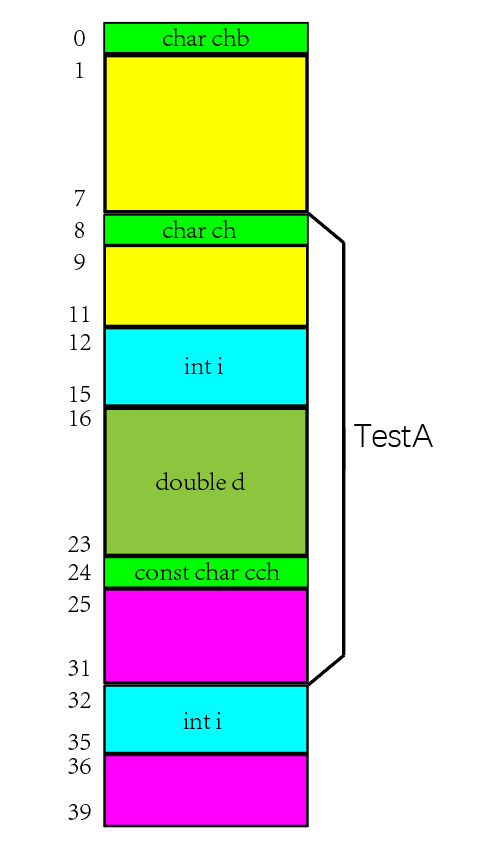
内存对齐规则:
- 结构体内的第一个变量相对于首地址的偏移量为
0 - 结构体内其余变量的起始地址是
min(sizeof(变量), 系统对齐模数)结果的整数倍 - 所有变量对齐结束后,再对结构体整体进行对齐。整体占用的内存大小要为
min(max(变量1,变量2,..), 系统对齐模数)结果的整数倍 - 若存在结构体嵌套,则将子结构体中的最大的数据类型作为子结构体的内存对齐标准
// 查看系统默认的对齐模数
// 64 位:默认 8
// 32 位:默认 4
#pragma pack(show)

// #pragma pack(n) 可修改对齐模数,n 为 2 的任意次幂例如1,2,4,8...
// 缺省,使用默认的对齐模数
#pragma pack()
struct TestA{
    char ch;
    int i;
    double d;
    const char cch;
};

struct TestB{
    char chb;
    struct TestA a;
    int ib;
};
#pragma pack()
// 查看系统默认的对齐模数
// 64 位:默认 8
// 32 位:默认 4
#pragma pack(show)
// #pragma pack(n) 可修改对齐模数,n 为 2 的任意次幂例如1,2,4,8...
// 缺省,使用默认的对齐模数
#pragma pack()
struct TestA{
char ch;
int i;
double d;
const char cch;
};
struct TestB{
char chb;
struct TestA a;
int ib;
};
#pragma pack()
公式
// TYPE: 需要进行内存对齐的变量类型
// align: 字节对齐模数 = min(..., 系统对齐模数)

/* 公式一
    需要对齐的字节数: sizeof(TYPE) == 23
    字节对齐模数: align == 4
    对齐后字节:(23 + 4 - 1) / 4 = 6;  6 * 4 = 24
*/
( (sizeof(TYPE) + align -1) / align ) * align

/* 公式二
   sizeof(TYPE) + align - 1: 将 sizeof(TYPE) / align 的倍数值加一,例如 (22 + 4 - 1) 将 22 (22 / 4 == 5) 扩展到了 25 (25 / 4 == 6),倍数加一
   & ~(align -1)) : 将多分配的内存裁剪掉,同 25 - 25 % 4 == 24
*/
((sizeof(TYPE) + align -1) & ~(align -1))

/* 公式三 */
((8*sizeof(TYPE) + 8*align -1)>>k)<<n
// TYPE: 需要进行内存对齐的变量类型
// align: 字节对齐模数 = min(..., 系统对齐模数)
/* 公式一
需要对齐的字节数: sizeof(TYPE) == 23
字节对齐模数: align == 4
对齐后字节:(23 + 4 - 1) / 4 = 6; 6 * 4 = 24
*/
( (sizeof(TYPE) + align -1) / align ) * align
/* 公式二
sizeof(TYPE) + align - 1: 将 sizeof(TYPE) / align 的倍数值加一,例如 (22 + 4 - 1) 将 22 (22 / 4 == 5) 扩展到了 25 (25 / 4 == 6),倍数加一
& ~(align -1)) : 将多分配的内存裁剪掉,同 25 - 25 % 4 == 24
*/
((sizeof(TYPE) + align -1) & ~(align -1))
/* 公式三 */
((8*sizeof(TYPE) + 8*align -1)>>k)<<n