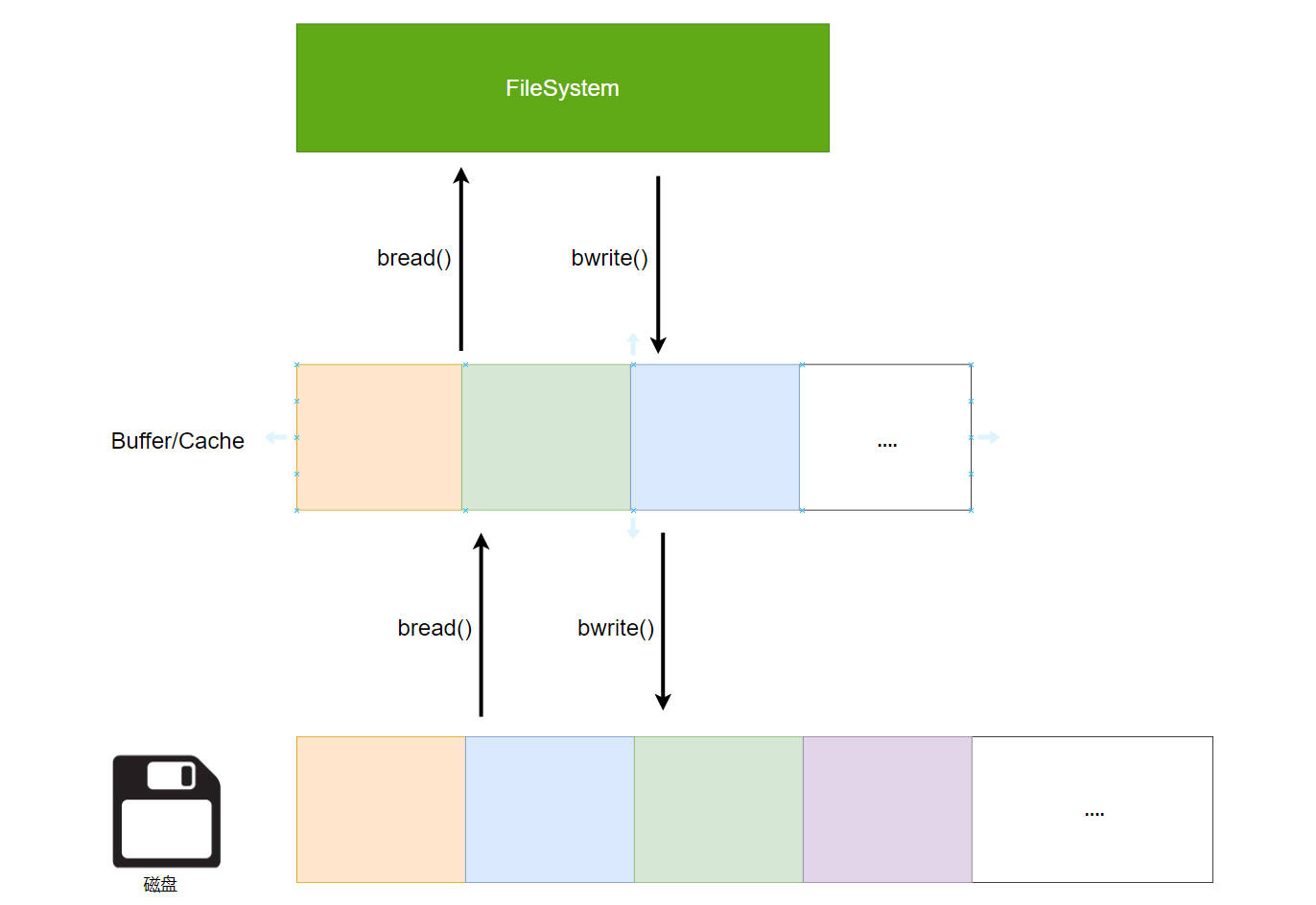
文件系统框架
结构
// Disk layout:
// [ boot block | sb block | log | inode blocks | free bit map | data blocks ]

int nbitmap = FSSIZE/(BSIZE*8) + 1;
int ninodeblocks = NINODES / IPB + 1;
int nlog = LOGSIZE;
int nmeta;    // Number of meta blocks (boot, sb, nlog, inode, bitmap)
int nblocks;  // Number of data blocks
// Disk layout:
// [ boot block | sb block | log | inode blocks | free bit map | data blocks ]
int nbitmap = FSSIZE/(BSIZE*8) + 1;
int ninodeblocks = NINODES / IPB + 1;
int nlog = LOGSIZE;
int nmeta; // Number of meta blocks (boot, sb, nlog, inode, bitmap)
int nblocks; // Number of data blocks
-
boot block: 存放操作系统启动加载器的区域 -
log: 实现崩溃一致性的日志 -
superblock:文件系统的元数据
#include "kernel/fs.h"

struct superblock {
  uint magic;        // Must be FSMAGIC
  uint size;         // Size of file system image (blocks)
  uint nblocks;      // Number of data blocks
  uint ninodes;      // Number of inodes.
  uint nlog;         // Number of log blocks
  uint logstart;     // Block number of first log block
  uint inodestart;   // Block number of first inode block
  uint bmapstart;    // Block number of first free map block
};
#include "kernel/fs.h"
struct superblock {
uint magic; // Must be FSMAGIC
uint size; // Size of file system image (blocks)
uint nblocks; // Number of data blocks
uint ninodes; // Number of inodes.
uint nlog; // Number of log blocks
uint logstart; // Block number of first log block
uint inodestart; // Block number of first inode block
uint bmapstart; // Block number of first free map block
};
inode blocks: 文件元数据存放块
// On-disk inode structure
struct dinode {
  short type;           // File type
  short major;          // Major device number (T_DEVICE only)
  short minor;          // Minor device number (T_DEVICE only)
  short nlink;          // Number of links to inode in file system
  uint size;            // Size of file (bytes)
  uint addrs[NDIRECT+1];   // Data block addresses
};
// On-disk inode structure
struct dinode {
short type; // File type
short major; // Major device number (T_DEVICE only)
short minor; // Minor device number (T_DEVICE only)
short nlink; // Number of links to inode in file system
uint size; // Size of file (bytes)
uint addrs[NDIRECT+1]; // Data block addresses
};
-
free bit map: 按照位来标记 block 的使用情况 -
data blocks: 数据块
接口
- 块读写操作
void rsect(uint sec, void *buf);
void wsect(uint sec, void *buf);
void rsect(uint sec, void *buf);
void wsect(uint sec, void *buf);
- inode 操作
// 在磁盘创建 inode
// 1. 初始化一个 inode
// 2. 将 inode 通过 winode 写入磁盘
uint ialloc(ushort type);

// 读取一个 inode
// 1. 计算 inum 所在块索引
// 2. rsect 读取块
// 3. 计算 inum 在块中位置,读取 inode
void rinode(uint inum, struct dinode *ip); // 读

// 写一个 inode
// 1. 计算 inum 所在块索引
// 2. rsect 读取块
// 3. 计算 inum 在块中位置,替换 inode
// 4. wsect 将修改后的块写入磁盘
void winode(uint inum, struct dinode *ip); // 写
// 在磁盘创建 inode
// 1. 初始化一个 inode
// 2. 将 inode 通过 winode 写入磁盘
uint ialloc(ushort type);
// 读取一个 inode
// 1. 计算 inum 所在块索引
// 2. rsect 读取块
// 3. 计算 inum 在块中位置,读取 inode
void rinode(uint inum, struct dinode *ip); // 读
// 写一个 inode
// 1. 计算 inum 所在块索引
// 2. rsect 读取块
// 3. 计算 inum 在块中位置,替换 inode
// 4. wsect 将修改后的块写入磁盘
void winode(uint inum, struct dinode *ip); // 写
- 往 inode 中添加数据
// 1. 目录 inum 对应 inode
// 2. rsect 读取目录的数据块
// 3. 数据块中添加数据 xp
// 4. wsect 将修改数据块写回磁盘
// 5. winode 更新 inode
void iappend(uint inum, void *xp, int n)
// 1. 目录 inum 对应 inode
// 2. rsect 读取目录的数据块
// 3. 数据块中添加数据 xp
// 4. wsect 将修改数据块写回磁盘
// 5. winode 更新 inode
void iappend(uint inum, void *xp, int n)
根目录的初始化
// 目录中的一条信息
struct dirent {
  ushort inum; // inode 索引
  char name[DIRSIZ]; // 条目名
} de;

// 初始化所有的 block
for(i = 0; i < FSSIZE; i++)
wsect(i, zeroes);

// 初始化 superblock
memset(buf, 0, sizeof(buf));
memmove(buf, &sb, sizeof(sb));
wsect(1, buf);

// 创建一个 T_DIR 的 inode,即根目录创建
rootino = ialloc(T_DIR);
assert(rootino == ROOTINO);

// 往根目录中写入一个 . 目录
bzero(&de, sizeof(de));
de.inum = xshort(rootino);
strcpy(de.name, ".");
iappend(rootino, &de, sizeof(de));

// 往根目录中写入一个 .. 目录
bzero(&de, sizeof(de));
de.inum = xshort(rootino);
strcpy(de.name, "..");
iappend(rootino, &de, sizeof(de));
// 目录中的一条信息
struct dirent {
ushort inum; // inode 索引
char name[DIRSIZ]; // 条目名
} de;
// 初始化所有的 block
for(i = 0; i < FSSIZE; i++)
wsect(i, zeroes);
// 初始化 superblock
memset(buf, 0, sizeof(buf));
memmove(buf, &sb, sizeof(sb));
wsect(1, buf);
// 创建一个 T_DIR 的 inode,即根目录创建
rootino = ialloc(T_DIR);
assert(rootino == ROOTINO);
// 往根目录中写入一个 . 目录
bzero(&de, sizeof(de));
de.inum = xshort(rootino);
strcpy(de.name, ".");
iappend(rootino, &de, sizeof(de));
// 往根目录中写入一个 .. 目录
bzero(&de, sizeof(de));
de.inum = xshort(rootino);
strcpy(de.name, "..");
iappend(rootino, &de, sizeof(de));
Buffer/Cache
文件系统与磁盘交互的接口会涉及多次 rsect/wsect。为了对此进行优化,操作系统在内存中创建了 Buffer/Cache 的磁盘数据缓冲区,减少与磁盘的读写次数