多线程
状态机
- 状态:
- 全局变量、堆区:所有线程共享
- 栈帧:每个线程独自维护自己的栈帧链
- 线程局部变量:每个线程自己的全局变量
CPP
// GCC 关键字
// 只适用于整型指针的标量,不带自定义的构造、拷贝、赋值、析构的类型;
// 不能修饰函数的局部变量或者class的普通成员变量
__thread int n;

// c11 标准,比上面那个好用
thread_local int n;
// GCC 关键字 // 只适用于整型指针的标量,不带自定义的构造、拷贝、赋值、析构的类型; // 不能修饰函数的局部变量或者class的普通成员变量 __thread int n; // c11 标准,比上面那个好用 thread_local int n;
- 多线程状态转移:不同栈帧链间并行执行,同一条栈帧链串行执行,且栈帧链之间互不影响
- 线程的创建: 就是在状态机中,新增加一条栈帧链表
- 线程 Join: 在主栈帧链中,循环等待被 Join 的栈帧链执行完毕
原子性
原子性:多个线程可以随意修改共享的内存资源
顺序性
顺序性:编译器编译程序,会将所有的代码视作单线程编译汇编语句,这样就会对代码进行乱七八糟的优化。优化后的代码在单线程上没问题,但是在多线程中,就会出现各种奇奇怪怪的问题
- 循环的优化
#include "thread.h"

// 累加循环数
#define N (100000)
// 累加和
long sum = 0;

void Sum()
{
    for (size_t i = 0; i < N; i++)
    {
        ++sum;
    }
}

int main(int argc, char const *argv[])
{
    create(Sum);
    create(Sum);
    join();
    printf("sum is %ld\n", sum);
    return 0;
}- 循环条件的优化
extern int flag = 0;

void Wait()
{
    while (!flag){}
}
经过编译器优化后,只在函数开始时,读取了一次 flag 值,这在单线程中完全没问题,但在多线程中,逻辑就完全错了:wait() 线程是要一直循环判断 flag 的值是否满足退出条件,但是编译器按照单线程逻辑进行优化,就只判断了一次 flag 的状态。防止编译器乱排序,可以使用 「内存屏障」或者利用原子变量的「内存顺」进行控制
extern int flag = 0;

void Wait()
{
    while (!flag){
        // 内存中的值已经改变,之前对内存的缓存(缓存到寄存器)都需要抛弃,之后需要重新读取内存
        asm volatile("":::"memory");
    }
}
可见性
可见性:汇编指令在处理器层面,会被进一步优化(全部当作是单线程程序),这就导致汇编指令的运行顺序也和定义的不一样
// 全局变量
int x = 0, y = 0;

// __attribute__:只适用于 GNU C
// __attribute__((noinline)) :函数不能内联
// __attribute__((always_inline)) :函数必须内联
__attribute__((noinline)) void write_x_read_y()
{
    x = 1;
    asm volatile("":::"memory");
    printf("%d ", y);
}

__attribute__((noinline)) void write_y_read_x()
{
    y = 1;
    asm volatile("":::"memory");
    printf("%d ", x);
}虽然添加了内存屏障,用两个线程分别跑上面的两个程序,输出结果也是违反直觉的
案例代码
#include "thread.h"

/* =================== 同步 ==================== */
// 原子变量标记
atomic_int flag;
// 读取标记
#define FLAG atomic_load(&flag)
// 0 ^ 0 = 0
// 1 ^ 1 = 0
// 0 ^ 1 = 1
// 1 ^ 0 = 1
#define FLAG_XOR(val) atomic_fetch_xor(&flag, val)
// 等待
#define WAIT_FOR(cond) \
  while (!(cond));
/* =================== 同步 ==================== */

// 全局变量
int x = 0, y = 0;

// __attribute__:只适用于 GNU C
// __attribute__((noinline)) :函数不能内联
// __attribute__((always_inline)) :函数必须内联
__attribute__((noinline)) void write_x_read_y()
{
  // x = 1;
  // asm volatile("":::"memory");
  // printf("%d ", y);

  int y_val;
  asm volatile(
      "movl $1, %0;" // x = 1
      "movl %2, %1;" // y_val = y
      : "=m"(x), "=r"(y_val)
      : "m"(y));
  printf("%d ", y_val);
}

__attribute__((noinline)) void write_y_read_x()
{
  // y = 1;
  // asm volatile("":::"memory");
  // printf("%d ", x);

  int x_val;
  asm volatile(
      "movl $1, %0;" // y = 1
      "movl %2, %1;" // x_val = x
      : "=m"(y), "=r"(x_val)
      : "m"(x));
  printf("%d ", x_val);
}

void T1(int id)
{
  while (1)
  {
    // 等待 flag 状态,第一位变成 1
    // while( (flag & 0b01) != true )
    WAIT_FOR((FLAG & 1));

    write_x_read_y();

    // 将 flag 的第一位变成 0
    FLAG_XOR(1);
  }
}

void T2()
{
  while (1)
  {
    // 等待 flag 状态,第二位变成 1
    // while( (flag & 0b10) != true )
    WAIT_FOR((FLAG & 2));

    write_y_read_x();

    // 将 flag 的二位变成 0
    FLAG_XOR(2);
  }
}

void Tsync()
{
  while (1)
  {
    // 初始化
    x = y = 0;
    __sync_synchronize(); // full barrier
    usleep(1);            // + delay
    assert(FLAG == 0);

    // flag = 0b11,停止 T1(),T2() 的等待
    FLAG_XOR(3);

    // 等待 T1(),T2() 运行完
    WAIT_FOR(FLAG == 0);

    printf("\n");
    fflush(stdout);
  }
}

int main()
{
  create(T1);
  create(T2);
  create(Tsync);
}这是因为,CPU 还会将汇编指令拆解成能在电路上运行的 $\mu op$ 语句,$\mu op$ 具有四个阶段:
- Fetch:从汇编指令获取 $\mu op$
- Issue:向处理器的运行池子中补充 $\mu op$
- Execute:处理器正式运行 $\mu op$
- Commit
在处理器内部,$\mu op$ 池子中,$\mu op$ 根据数据依赖关系与 $\mu op$ 的补充顺序形成一个有向无环图,处理器根据这个有向无环图执行 $\mu op$ 。根据这样的设计,这些 $\mu op$ 便可以在处理器中并发执行,因此就导致汇编指令在处理器中也会被优化得乱七八糟运行。
movl $1, %0; // y = 1
movl %2, %1; // x_val = x
当上面两条汇编指令同时被加载到处理器的缓存中,就会同时获取两条指令的 $\mu op$,但这两天指令间并没有数据依赖关系,这就导致 $\mu op$ 会被随意排序,进而导致运行结果会产生 0 0 的结果。为了防止处理器对汇编顺序的优化,可以使用 mfence
movl $1, %0; // y = 1
mfence; // 保证上面的汇编指令真正的被执行完毕,才开始执行下面的汇编指令
movl %2, %1; // x_val = x
互斥
互斥问题
导致互斥不能很好实现的根本原因是:不能同时进行读、写共享内存
- load/read:看一眼共享内存,但是看到的内容马上过时,不能防止别人写
- store/write:往共享内存中写入内容,但是共享内存中有啥东西完全不知道
Peterson
// 两个线程的标记
#define T1 (1)
#define T2 (2)

// 标记,这里来必须使用 volatile 保证全局变量能被写入到内存
volatile int flagT1 = 0; // T1 想要进入
volatile int flagT2 = 0; // T2 想要进入
volatile int turn = T1;  // 实际让那个线程进入

// 临界区资源
atomic_int count;

void FcnT1()
{
    while (1)
    {
        // 当前线程想进入
        flagT1 = 1;
        // 让 T2 先进
        turn = T2;
        // 等待 T2 运行完毕
        while (flagT2 && turn == T2);

        /* ==================== */
        atomic_fetch_add(&count , 1);
        int temp = atomic_load(&count);
        if ( temp > 1 )
        {
            printf("T1 count is %d\n", temp);
        }
        atomic_store(&count, 0);
        /* ==================== */

        // T1 退出
        flagT1 = 0;
    }
}

void FcnT2()
{
    while (1)
    {
        // 当前线程想进入
        flagT2 = 1;
        // 让 T1 先进
        turn = T1;
        // 等待 T1 运行完毕
        while (flagT1 && turn == T1);

        /* ==================== */
        atomic_fetch_add(&count , 1);
        int temp = atomic_load(&count);
        if ( temp > 1 )
        {
            printf("T2 count is %d\n", temp);
        }
        atomic_store(&count, 0);
        /* ==================== */

        // T2 退出
        flagT2 = 0;
    }
}Peterson 算法通过共享内存的方式(flagT1、flagT2、turn就是用来实现互斥的全局变量)实现了线程间的互斥。在理论上该算法是正确的,但是由于处理器运行的不可见性,还是会出现问题。
自旋锁
原理
解决互斥问题,改变前提:让硬件提供支持同时 load/store 的指令,即同一时间只有一个线程能读取并修改共享内存,其他线程不能干涉
int xchg(volatile int *addr, int newval) {
    int result;
    // lock : 保证修饰的汇编语句是原子操作
    // xchg : 读写操作,放入新值,返回旧值
    asm volatile ("lock xchg %0, %1"
      : "+m"(*addr), "=a"(result)
      : "1"(newval));
    return result;
}

/* 自旋锁实现 */
int table = YES;

void lock() {
  while (xchg(&table, NOPE) == NOPE);
  assert(got == YES);
}

void unlock() {
  xchg(&table, YES)
}lock 指令
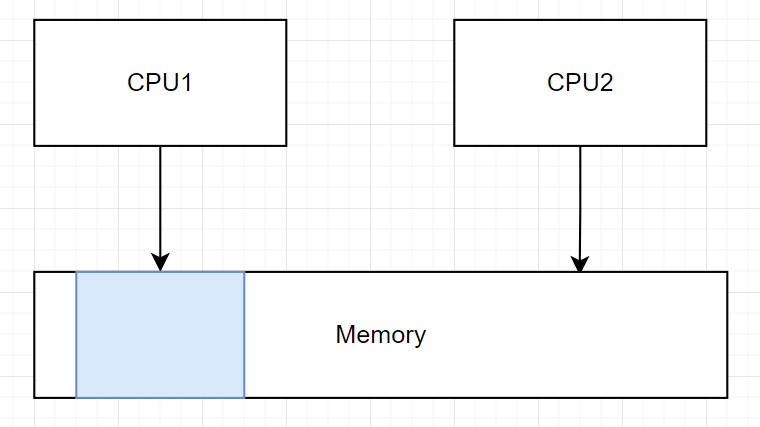
对于上述的 lock 指令,在简单的内存模型上,可以通过硬件实现:CPU1 与 CPU2 直接访问内存,无缓存;CPU1 要实现对蓝色区域内存的原子操作,就直接在物理上给这片内存区域上一个锁;在 CPU1 访问这片内存期间,CPU2 无法访问蓝色区域内存,直到 CPU1 解除锁定。
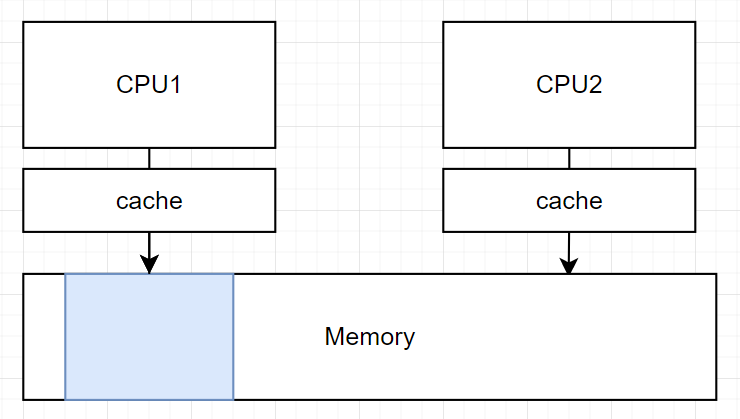
但是这种设计在现代内存模型上,就不太合理。现代内存模型,CPU 与内存之间还存在 cache ,CPU 会经过 cache 来访问内存,cache 会拷贝内存上的内容。通过物理封锁内存实现 CPU1 对蓝色区域内存的原子操作,这种方法就行不通了,万一 CPU1 与 CPU2 的 cache 刚好都是蓝色区域的副本,这样程序又乱套了。想要彻底锁着蓝色区域的内存,就需要 CPU1 锁住蓝色区域内存的同时,还要清空掉 CPU2 的 cache ,代价就太大了。观察常见的几种原子操作
/* test and set */
void TestAndSet(Type & x, Type newVal)
{
    reg = load(x);        // 读取
    if(IsCondition(reg))  // 检测状态
    {
        store(x, newVal); // 写入
    }
}

/* xchg */
void xchg(Type & x, Type newVal)
{
    reg = load(x);    // 读取
    store(x, newVal); // 写入
}

/* compute */
void compute(Type & x)
{
    reg = load(x); // 读取
    operate(reg);  // 运算
    store(x, reg); // 写入
}上面三种原子操作的步骤都可以总结为:
- load : 读取内存
- operate : 各种乱七八糟的计算操作
- store : 将修改的内容更新到内存
确保原子操作能正常运行,就只要保证 load 与 store 正常就行,operate 无所谓,可以随时复现。RISC-V 提供了另外一种原子操作的设计思路 Load-Reserved/Store-Conditional(LR/SC)
- LR : 原子操作读取内存时,会对被访问的内存添加标记。中断、其他处理器写入内容到标记内存中,都会导致标记清除
CPP
 lr.w  rd, (rs1);
 {
     rd = M[rs1];    // 读取内存内容
     reserve M[rs1]; // 标记当前内存
 }
lr.w rd, (rs1); { rd = M[rs1]; // 读取内存内容 reserve M[rs1]; // 标记当前内存 } - SC : 若标记没被清除,就将更新内存
CPP
 sc.w  rd, rs2, (rs1);
 {
     // 标志是否还存在
     if (IsReserve(rs1) == true)
     {
         M[rs1] = rs2; // 将新值写入 M[rs1]
         rd = 0;       // 清空当前缓存
     }
     else
     {
         rd = nonzero;
     }
 }
sc.w rd, rs2, (rs1); { // 标志是否还存在 if (IsReserve(rs1) == true) { M[rs1] = rs2; // 将新值写入 M[rs1] rd = 0; // 清空当前缓存 } else { rd = nonzero; } }
实战案例:通过 LR 与 SC 实现 CAS (compare and swap) 原子操作
cas:
    lr.w    oldVal, (add)           # 从内存中读取值
    bne     oldVal, expVal, fail    # 与期望值比较,一样就继续,不一样就返回
    sc.w    oldval, newVal, (add)   # 往内存中写入新值
    bnez    oldVal, cas             # oldVal 不为 0 就继续尝试写入
    li      oldVal, 0               # 操作成功
    jr      ra
fail:
    li      oldVal, 1               # 操作失败
jr ra自旋的使用
缺陷
- 自旋 (共享变量) 会触发处理器间的缓存同步,
- 除了进入临界区的线程,其他处理器上的线程都在空转
- 操作系统不知道拿到锁的线程在干啥,万一这个线程跑去 sleep ,那么所有资源就 100% 浪费
使用要求:
- 临界区的访问基本不会发生冲突
- 持有自选锁的线程要一直能工作,不会被打断,例如中断、堵塞、时间片切换出去等
Note
自旋锁的真正使用场景就只剩操作系统内核的并发数据结构 (短临界区)
睡眠锁
发生共享资源竞争的是用户态下的线程,在用户态下的程序不能很好的实现锁的管理,那就把这些破事扔给权限更高的操作系统来管理。操作系统底层利用自旋锁实现提供给用户程序的锁是原子的,然后用户程序拿着这些原子锁就能解决自己的互斥问题了,这些操作系统提供给用户的锁就是「睡眠锁」。
// 系统调用获取一把锁 lk,若获取失败,就把当前线程给睡了
syscall(SYSCALL_lock, &lk);

// 释放 lk 锁,并唤醒一个正在等待锁的线程
syscall(SYSCALL_unlock, &lk);Futex
自旋锁:
- fast path : 一条原子指令就能拿到锁,并进入临界区
- slow path : CPU 忙等,浪费性能
睡眠锁:
- fast path : 系统调用去拿锁,浪费性能
- slow path : 上锁失败后,系统调用阻塞等待,让出 CPU
Futex: 对上面两种锁进行优化,也是现代操作系统「互斥锁」的实现
- fast path : 一条原子指令就能拿到锁,不会产生系统调用
- slow path : 上锁失败后,就阻塞等待,让出 CPU
# 锁和等待队列
locked, waits = '', ''

# 原子操作,获取锁
def atomic_tryacquire():
    if not locked:
        # Test-and-set (cmpxchg)
        # Same effect, but more efficient than xchg
        locked = '🔒'
        return ''
    else:
        return '🔒'

# 系统调用唤醒其他等待锁的线程
def release():
    if waits:
       waits = waits[1:]
    else:
        self.locked = ''

@thread
def Run():
    while True:
        if atomic_tryacquire() == '🔒':     # User
            # 拿锁失败,系统调用去内核态睡觉
            # NOTE - 实际上并没有这个 while 循环,只是示意一下睡眠等待
            waits = waits + '1'             # Kernel
            while '1' in waits:             # Kernel
                pass
        do_something()                      # User
release() # Kernel同步
生产者-消费者模型
Note
线程同步:在某个时间点共同达到互相已知的状态。而利用生产者-消费者模型,就能解决 99% 的线程同步问题。
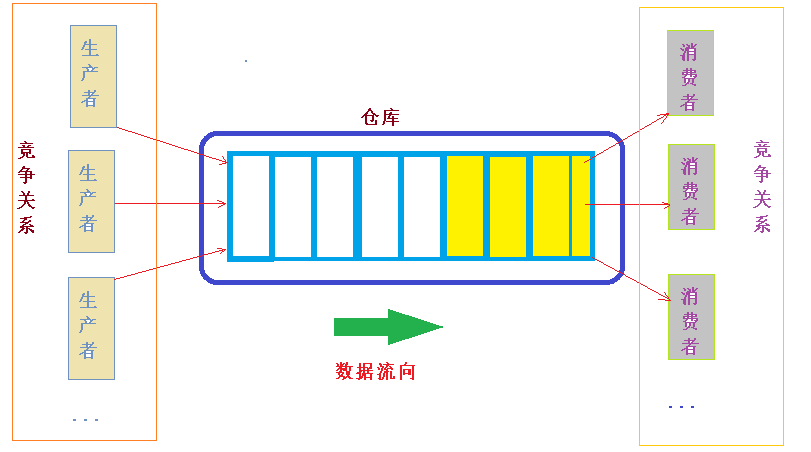
生产者-消费者模型:
- 有一个临界区存放资源
- 临界区有空闲,生产者才能放入资源
- 临界区有资源,消费者才能取出资源
互斥锁
Tip
多线程生成 () ,生成的括号满足左右括号匹配关系,且限制括号的最大嵌套层次
int assetMax = 3;   // 最大括号深度
int assetCount = 0; // 资源个数,临界区仓库
pthread_mutex_t mutex = PTHREAD_MUTEX_INITIALIZER;

// 生产
void Product()
{
    int count = 100;
    while (--count)
    {
        pthread_mutex_lock(&mutex);
        while (assetCount >= assetMax )
        {
            // 释放锁,让消费者抢到锁进行消费
            pthread_mutex_unlock(&mutex);

            // 加锁,查看是否能生产资源
            pthread_mutex_lock(&mutex);
        }

        // 生产
        printf("(");

        // 更新仓库
        ++assetCount;

        pthread_mutex_unlock(&mutex);
    }
}

// 消费
void Consume()
{
    int count = 100;
    while (--count)
    {
        pthread_mutex_lock(&mutex);
        while (assetCount <= 0)
        {
            // 释放锁,让生产者抢到锁进行生产
            pthread_mutex_unlock(&mutex);

            // 加锁,查看有没有资源
            pthread_mutex_lock(&mutex);
        }

        // 消费
        printf(")");

        // 更新仓库
        --assetCount;

        pthread_mutex_unlock(&mutex);
    }
}利用互斥锁实现的生产者消费者模型,消费者线程与生产者线程均是通过 while() 循环忙等来实现线程间的同步,这样就十分浪费CPU资源,不合理。
条件量
int assetMax = 3;   // 最大资源数
int assetCount = 0; // 资源个数

pthread_mutex_t mutex = PTHREAD_MUTEX_INITIALIZER;

pthread_cond_t condProduct = PTHREAD_COND_INITIALIZER; // 可以生产的条件
pthread_cond_t condConsume = PTHREAD_COND_INITIALIZER; // 可以消费的条件

// 生产
void Product()
{
    int count = 100;
    while (--count)
    {
        pthread_mutex_lock(&mutex);
        if (assetCount >= assetMax )
        {
            // 释放锁,让消费者抢到锁进行消费
            pthread_cond_wait(&condProduct, &mutex);
        }

        printf("(");
        ++assetCount;

        pthread_cond_signal(&condConsume);
        pthread_mutex_unlock(&mutex);
    }
}

// 消费
void Consume()
{
    int count = 100;
    while (--count)
    {
        pthread_mutex_lock(&mutex);
        if (assetCount <= 0)
        {
            // 释放锁,让生产者抢到锁进行生产
            pthread_cond_wait(&condConsume, &mutex);
        }

        printf(")");
        --assetCount;

        pthread_cond_signal(&condProduct);
        pthread_mutex_unlock(&mutex);
    }
}引入条件量,替换互斥锁中的忙等。当条件不满足时,条件量就会将当前线程睡眠,等待条件满足后被唤醒。
while (assetCount >= assetMax )
{
    // 释放锁,让消费者抢到锁进行消费
    pthread_mutex_unlock(&mutex);

    // 加锁,查看是否能生产资源
    pthread_mutex_lock(&mutex);
}

/* ================================== */

if (assetCount >= assetMax )
{
    // 释放锁,让消费者抢到锁进行消费
    pthread_cond_wait(&condProduct, &mutex);
}上面用两个条件量来实现生产者与消费者的同步,就会增加程序的复杂性。为了代码编写简洁,可以套用模版
/* ================== 等待条件 =================== */
pthread_mutex_lock(&mutex);
while ( /* 判断条件 */ )
{
    // 释放锁,让消费者抢到锁进行消费
    pthread_cond_wait(&cond, &mutex);
}

/* 处理逻辑 */

pthread_mutex_unlock(&mutex);

/* ================== 通知条件成立 ================= */
pthread_cond_broadcast(&cond);
改写上面的生产者消费者模型
int assetMax = 3;   // 最大资源数
int assetCount = 0; // 资源个数
pthread_mutex_t mutex = PTHREAD_MUTEX_INITIALIZER;

pthread_cond_t cond = PTHREAD_COND_INITIALIZER;

// 生产
void Product()
{
    int count = 100;
    while (--count)
    {
        pthread_mutex_lock(&mutex);
        while (assetCount >= assetMax )
        {
            // 释放锁,让消费者抢到锁进行消费
            pthread_cond_wait(&cond, &mutex);
        }

        printf("(");
        ++assetCount;

        pthread_mutex_unlock(&mutex);
        pthread_cond_broadcast(&cond);
    }
}

// 消费
void Consume()
{
    int count = 100;
    while (--count)
    {
        pthread_mutex_lock(&mutex);
        while (assetCount <= 0)
        {
            // 释放锁,让生产者抢到锁进行生产
            pthread_cond_wait(&cond, &mutex);
        }

        printf(")");
        --assetCount;

        pthread_mutex_unlock(&mutex);
        pthread_cond_broadcast(&cond);
    }
}信号量
#include <semaphore.h>

sem_t asset;
sem_t empty;

// 生产
void Product()
{
    int count = 100;
    while (--count)
    {
        // 等待有空位
        sem_wait(&empty);

        printf("(");

        // 生产了一个资源
        sem_post(&asset);
    }
}

// 消费
void Consume()
{
    int count = 100;
    while (--count)
    {
        // 等待有资源
        sem_wait(&asset);

        printf(")");

        // 消费了一个资源
        sem_post(&empty);
    }
}哲学家问题
安全稳妥的解决方案:
- 通过第三方对象来管理资源
- 条件变量模版
Note
对于复杂的多线程问题,越简单的方案,越稳妥,少用花里胡哨的技巧;且优先实现功能,再谈性能。
// 人数
#define NUM (10)

// 筷子
#define IDLE (0)
#define USED (1)
int chopsticks[NUM] = {IDLE};

pthread_mutex_t mutex = PTHREAD_MUTEX_INITIALIZER;
pthread_cond_t cond = PTHREAD_COND_INITIALIZER;

void Philosopher(int id)
{
    // 左手筷子
    int lChopstick = (id - 1) % NUM;
    // 右手筷子
    int rchopstick = id % NUM;

    while(1)
    {
        /* 获取资源 */
        pthread_mutex_lock(&mutex);
        // 等待筷子
        while( chopsticks[lChopstick] == USED ||
               chopsticks[rchopstick] == USED)
        {
            pthread_cond_wait(&cond, &mutex);
        }

        // 拿筷子
        chopsticks[lChopstick] = USED;
        chopsticks[rchopstick] = USED;
        pthread_mutex_unlock(&mutex);

        /* 处理 */
        // 使用筷子
        printf("thread %d get %d %d\n", id, lChopstick ,rchopstick);

        /* 归还资源 */
        pthread_mutex_lock(&mutex);
        // 归还筷子
        chopsticks[lChopstick] = IDLE;
        chopsticks[rchopstick] = IDLE;
        pthread_cond_broadcast(&cond);
        pthread_mutex_unlock(&mutex);
    }
}BUG
防御性编程
- 明确把自己的想法告诉编译器
CPP
 /* 程序运行结果与期望进行对比 */
 assert(condition());
/* 程序运行结果与期望进行对比 */ assert(condition()); - 检测变量的合法性
死锁
问题
AA - Deadlock :在操作系统中,一个线程导致的死锁
void os_run()
{
    spin_lock(&lock);
    ....
    // 由于乱起八糟操作,把中断打开了
    recover_interrupt();
    ....
    spin_unlock(&lock);
}

void interrupt()
{
    // os_run 持有 lock 的时候,中断介入获取 lock ,就导致 AA - Deadlock
    spin_lock(&lock);
    ....
    spin_unlock(&lock);
}ABBA - Deadlock :多把锁,但是线程获取锁的顺序有问题,导致死锁。
void Run(int i, int j) {
    spin_lock(&lock[i]);
    spin_lock(&lock[j]);
    ...
    spin_unlock(&lock[j]);
    spin_unlock(&lock[i]);
}

// 下面两个线程抢锁
Run(1,2);
Run(2,1);lockdep
为了防止出现 ABBA 死锁,解决方案就是规定一个全局的获取锁的顺序规则,获取锁都根据这个规则来。但是当程序规模太庞大时,就不能确保锁的获取真的根据这个顺序进行,例如多个人组团开发。为了检测出问题,就可以使用 lockdep 方法
- 每一类锁,给一个唯一标识(注意不是锁实例化的时候,而是锁在程序中被定义的时候),这个标志可以是锁初始化时,程序所在的文件行号
- 上锁和解锁的时候,打印锁标识,形成日志文件
- 将日志文件中的上锁顺序绘制成图,查找是否存在循环边,就能知道是否违法了上锁顺序。
Tip
上面通过程序运行过程中打印日志,再检测日志的程序检测手段,称之为「动态程序分析」
数据竞争
Tip
两个及其以上的线程,同时访问同一内存,至少一个线程执行写操作。
利用「互斥锁」保护好数据,就能避免一切数据竞争。
检测工具
- asan (AddressSanitizer) :内存检测
- tsan (threadSanitizer) : 数据竞争检测
- msan (memorySanitizer) : 未初始化的读取
- ubsan (UBSanitizer) : 未定义行为
cannary
在分配的堆内存前后添加缓冲区,用来标记当前堆内存是否发生了越界。
#define MAGIC (0x55558888)
#define NUM (0x4096)

struct Memory
{
    // 开始保护区
    int32_t headBlock = MAGIC;
    // 内存使用区域
    char usageBlock[NUM];
    // 结束保护区
    int32_t tailBlock = MAGIC;
}

// 前后保护区出问题,那就说明这片内存出问题了
bool cannary_check(Memory * mem)
{
    if(mem->headBlock != MAGIC)
    {
        return false;
    }
    if(mem->tailBlock != MAGIC)
    {
        return false;
    }
    return true;
}附录
python 装饰器
闭包: 在函数中再嵌套一个函数,并且引用外部函数的变量,这就是一个闭包了
def outer(x):
    # 内部函数
    def inner(y):
        return x + y

    # 返回内部函数
    return inner

print(outer(6)(5))装饰器: 对上述的闭包操作进行简化
def Test(fcn):
    print("fuck you")
    return fcn

@Test
def Run():
    print("fuck you too")

# 首先调用 Test(),然后再调用 Run()
# Test 是 Run 的装饰器
Run()

""" ============ 闭包形式 ============= """
def Test():
    print("fuck you")
    def Run():
        print("fuck you too")
    return Run

Test()()带参数的装饰器
def logging(level):
    def outwrapper(func):
        def wrapper(*args, **kwargs):
            print("[{0}]: enter {1}()".format(level, func.__name__))
            return func(*args, **kwargs)
        return wrapper
    return outwrapper

@logging(level="INFO")
def hello(a, b, c):
    print(a, b, c)

# logging 接收装饰器参数;然后调用 outwrapper 接收函数;wrapper 接收函数参数然后调用函数
hello("hello,","good","morning")python 生成器
yield:遇到 yield 就返回结果并结束;下次再调用时,从上次 yield 离开的地方进入。
def Test():
    n = 0
    while(1):
        yield n
        n = n + 1

# 创建一个生成器
obj = Test()
print(obj)

# 逐步调用生成器
print(obj.__next__())
print(obj.__next__())
print(obj.__next__())eval
可以利用 eval 运行字符串表达式
def Display(str):
    print(str)

eval("Display('fuck you')")内联汇编
// 只支持 GCC 编译器,MSVC 不能这么玩
asm volatile(
        assembler template               /* 汇编语句 */
        : output operands                /* 输出操作数 */
        : input operands                 /* 输入操作数 */
        : list of clobbered registers    /* 寄存器 */
);GCC 汇编使用的是 AT&T/UNIX 汇编语法,命令形式为
// src : 源操作数
// dst : 目标操作数
OP-code src dst;

// $ : 立即数
// % : 寄存器
// l, b, w : 决定操作数的内存长度
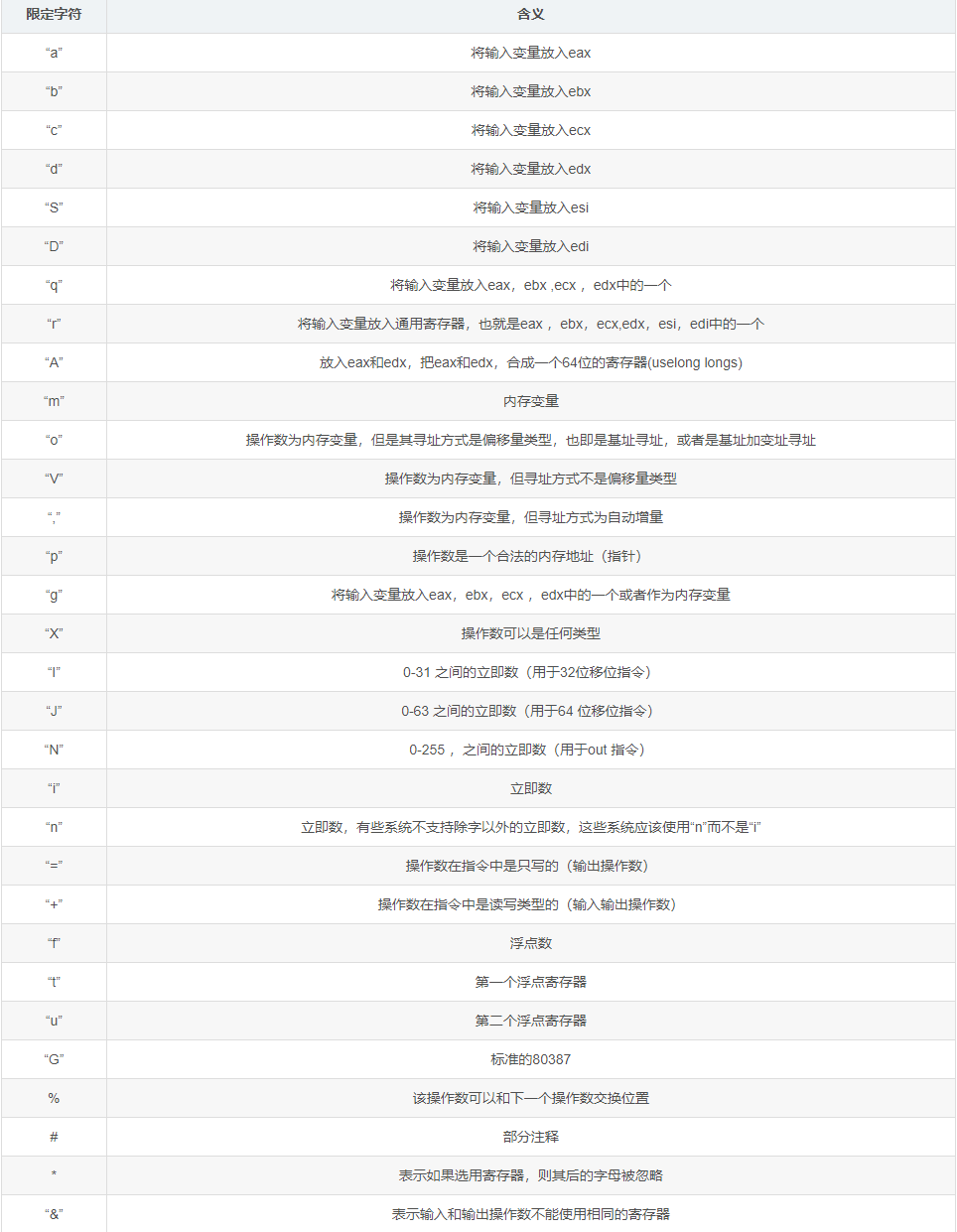
movl $250, %al;在内联汇编中,只允许同时存在10个操作数(输出操作数与输入操作数的总和),在 assembler template 语句中用 %0, %1, %2, %3 ... %9 表示,其中 0 - 9 数字表示操作数定义的先后顺序。由于 % 用来表示操作数了,因此 assembler template 中利用 %% 区分寄存器。
#include <stdio.h>

int main()
{
    int a = 10;
    int b = 20;
    int c;
    int d;

    asm("movl %3, %%eax \n"
        "movl %%eax, %1 \n"
        :"=b"(c),"=c"(d) // c 操作数编号 0;d 操作数编号 1
        :"d"(a),"S"(b) // a 操作数编号 2;b 操作数编号 3
        :"%eax"
        );

    printf("d = %d\n", d);
}操作数中符号的具体含义